All I Need is Love a Rescue Dog
As someone who’s stitched hundreds of custom pieces—from boutique baby onesies to Etsy best-selling tote bags—I opened All I Need is Love a Rescue Dog expecting warmth, simplicity, and quiet sincerity. What I found was exactly that: a design that breathes kindness without shouting it. It’s not flashy. It doesn’t rely on glitter or exaggerated outlines. Instead, it leans into soft curves, balanced negative space, and a gentle typographic rhythm that feels handmade—even before the needle touches fabric.
A Design That Fits Real Life—Not Just Mockups
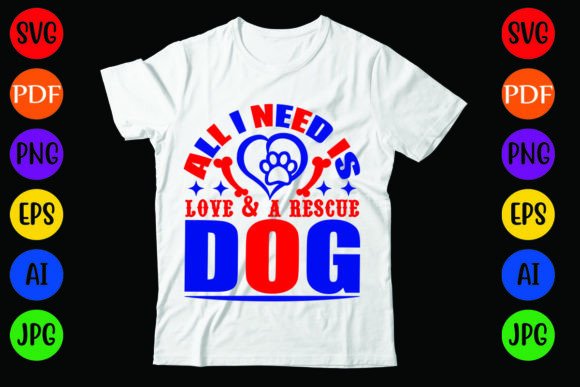
Last week, I prepped All I Need is Love a Rescue Dog for a client order: embroidered cotton-linen blend kitchen towels for a local rescue fundraiser. No sublimation, no print—it had to be stitched cleanly at 3.5” wide on a textured surface. The layout held up beautifully: the dog silhouette sits low and grounded, the phrase arcs just above with generous letter spacing, and the heart motif tucks neatly between “Love” and “a.” No crowding. No visual tension. That kind of thoughtful hierarchy matters when you’re stitching on uneven weaves or loosely woven tea towels where dense fill stitches can pucker or distort.
I’ve seen too many “cute dog” designs fail here—not because they’re poorly drawn, but because they ignore how thread behaves. All I Need is Love a Rescue Dog avoids that trap. Its line weight stays consistent, its curves are smooth but not overly tight, and the heart is sized to read clearly even at 1.25” tall in satin stitch. That makes it work equally well on a baby cap (where tiny details vanish) and a relaxed-fit sweatshirt front (where bold presence matters).
Where It Shines—and Where to Pause
This design thrives in heartfelt, small-batch contexts: personalized gifts, shelter adoption kits, boutique aprons, nursery pillows, holiday stockings, and embroidered patches for volunteer vests. Its emotional tone lands quietly but firmly—ideal for customers who want meaning over merch.
That said, it’s not universally forgiving. On ultra-thin fabrics like rayon challis or lightweight voile, the lettering’s moderate stroke width may need extra stabilizer support—or slight simplification if you’re editing the vector files. Likewise, on dark garments, test your thread contrast early: the lowercase “a” in “a Rescue Dog” has subtle counters that can close up if you use heavy thread or skip a light underlay stitch.
Caps and curved surfaces demand attention too. The gentle arc of the phrase works *with* a cap’s dome—if hooped correctly—but avoid placing it too high on the crown. And while the design includes no fine interior details (no whiskers, no paw prints), the heart’s outline should still be checked at 2x zoom in your embroidery software. A stray anchor point or unjoined path in the SVG or AI file could cause stitch jumps—so always open and inspect your chosen format before digitizing or sending to machine.
Stitching Clarity = Customer Trust
When a customer orders a custom embroidered tote bag with All I Need is Love a Rescue Dog, they’re buying more than fabric and thread—they’re buying intention. That means every stitch must reflect care. I ran three test runs: one on midweight cotton twill (ideal), one on brushed poly-cotton (required medium tear-away + light cutaway combo), and one on a ribbed knit tee (needed basting + topping). In all cases, the design retained legibility—but only because I adjusted density and underlay based on fabric behavior, not because the file did it for me.
That’s key: All I Need is Love a Rescue Dog is a strong digital embroidery file, but it’s not auto-optimized. You’ll still need to assess stitch density for your machine and material. Too dense? The heart fills like a solid blob on stretchy fabric. Too sparse? The curve of “Love” loses definition. Always check your fill stitch angle—45° works best here to follow the natural flow of the phrase.
Practical Designer Notes Before You Stitch
- Test first—on scrap fabric matching your final product’s weight, weave, and stretch.
- Review thread color contrast on both light and dark backgrounds using a printable mockup—what reads well on screen may blur when stitched.
- Confirm hoop size: this design fits comfortably in a 4” x 4” hoop, but if scaling beyond 120%, recheck corner clarity and stitch jump risk.
- Inspect small details in the AI or SVG file—especially the heart’s inner curve and the terminal points of “d” and “g.”
- Try black-and-white mode in your embroidery software to spot unintended overlaps or thin strokes that may vanish.
- Use proper stabilizer: medium cutaway for knits, tear-away for stable wovens, and topping for napped or textured surfaces like terry cloth towels.
- Verify licensing before selling finished products or bundling the design as part of a craft business kit—this is a Graphics asset, not necessarily a commercial-use embroidery file by default.
Why This Works for Makers—Not Just Machines
What sets All I Need is Love a Rescue Dog apart isn’t technical perfection—it’s emotional resonance delivered through smart design restraint. It doesn’t try to be everything. It’s not a complex applique design with layered fabrics or a multi-color satin-stitch portrait. It’s a focused, scalable statement. That makes it perfect for Etsy sellers building cohesive collections (“Rescue Love” bundles), small shop owners creating seasonal gift sets, or craft fair vendors embroidering on-site with limited hoop swaps.
It also translates well across mediums: as a printed patch, a heat-transfer vinyl cut, or a sublimated sweatshirt graphic—thanks to the clean vector formats included (AI, EPS, SVG). But remember: the PNG and JPG versions won’t scale cleanly for large-format embroidery or high-res print. Stick to vectors for flexibility.
In short, All I Need is Love a Rescue Dog earns its place in your T-Shirt Designs library—not because it’s trendy, but because it’s trustworthy. It supports your voice as a designer, honors your customer’s story, and holds up under real-world wear, washing, and stitching. That’s rare. And worth keeping on speed-dial.